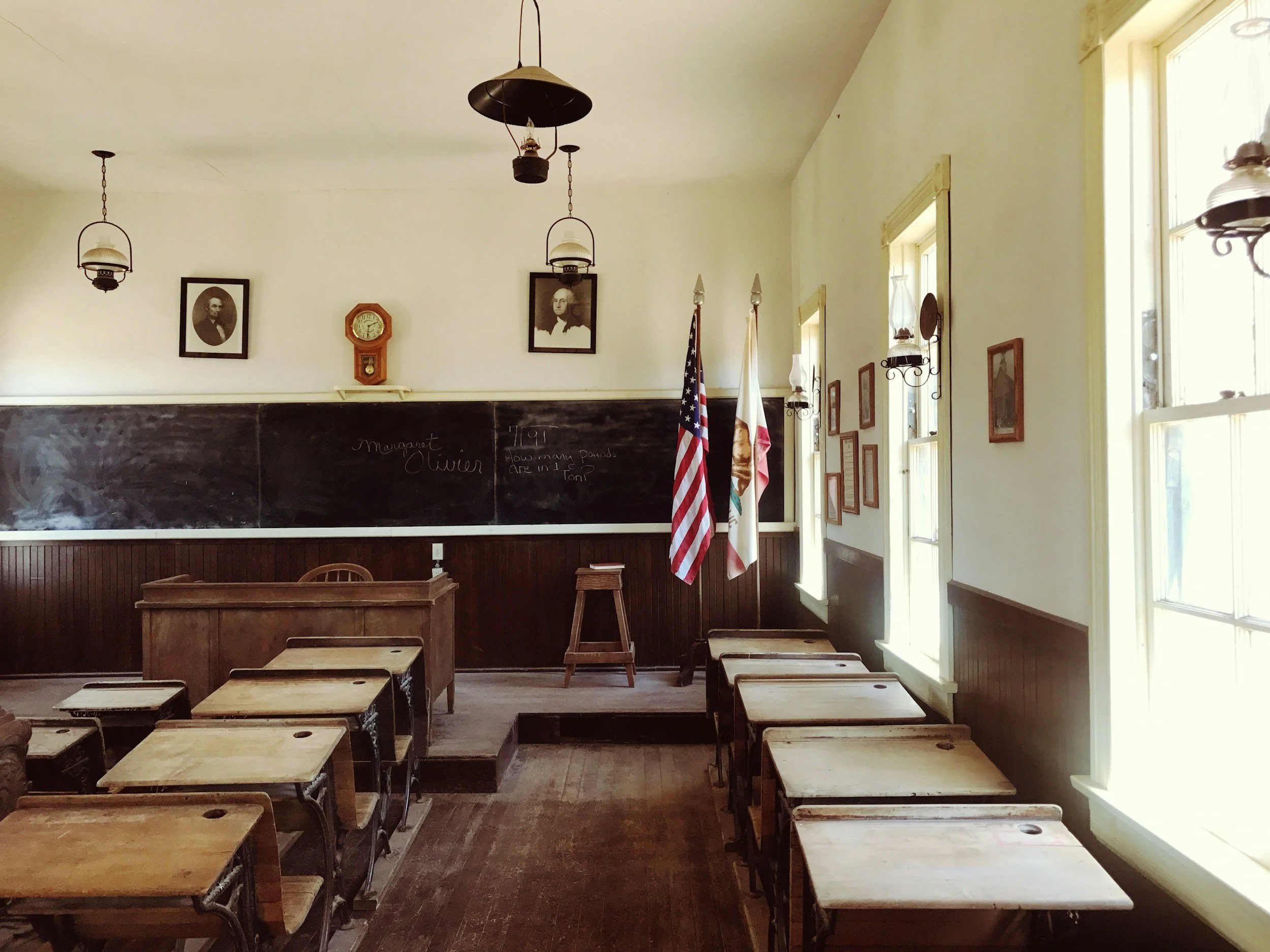
Country Schools
Paraphrased from the book The Story of McLean County and Its Schools by William B. Brigham (1951) and articles from issues of the Lexington Unit Journal and the 1955 Centennial Program Book
Country schools have a long and rich history in McLean County. When early settlers came from other states in the 1820s and 1830s schooling was needed for the children. Private subscription schools were opened in log cabin homes and parents paid a fee for their children’s education. Teachers in these early country schools were often young men or women who were only a year or two older than their pupils.
In 1825 the Illinois legislature passed a law to establish free schools. People were opposed to the law as they were not in favor of a tax to provide education for other people’s children. The law ultimately was repealed. At some point after 1837 the Illinois School Fund was established by collecting the interest on sales of public lands and the Township School Fund by collecting from the sale of and income from the 16th section of land. These small amounts could be bolstered by local taxation if approved by voters. In most places only a portion of the cost of maintaining a school was raised. Early log cabin schools were built primarily by private contributions and often were used not only as schools but also a place where religious meetings and neighborhood gatherings were held.
McLean County experienced a population boom in the 1850s. The passage of new laws provided local power for school districts and boards to levy taxes, build buildings and hire teachers. The number of students in settlements and villages demanded investments in multi-room elementary schools and often a separate high school building. Neighbors in rural areas pooled resources to provide one-room school houses within walking distance of most children. In only a few years there were new one-room school buildings dotting the landscape of the entire county. Restrictions were set by new state laws on distributions of monies, standards for buildings and equipment, teacher qualifications and courses of study. One-room schools thrived for 50 years.
Though one-room schools were serving adequately to educate children and provide a center of neighborhood social life, consolidation of rural schools was frequently discussed in the early 1900s. Muddy roads for many years prevented any possible transportation to distant centers even if larger units were organized.
In 1945 state law forced a study committee into existence in McLean County to survey the 230 one-room schools for reorganization. Findings showed many schools with small numbers of children, teacher shortages, and buildings in need of extensive repair. School consolidations followed and many small village schools joined with surrounding rural schools to form unit districts inclusive of grades one through twelve. Transportation by school buses on vastly improved county roads was an important key to the success of the reorganizations.
Many unused one-room buildings were sold at public auction. Today all but a few of the little one-room schoolhouses have vanished — either torn down or relocated. The ones that remain have been remodeled to serve as a dwelling and are no longer recognizable as a former school.
Money Creek Township
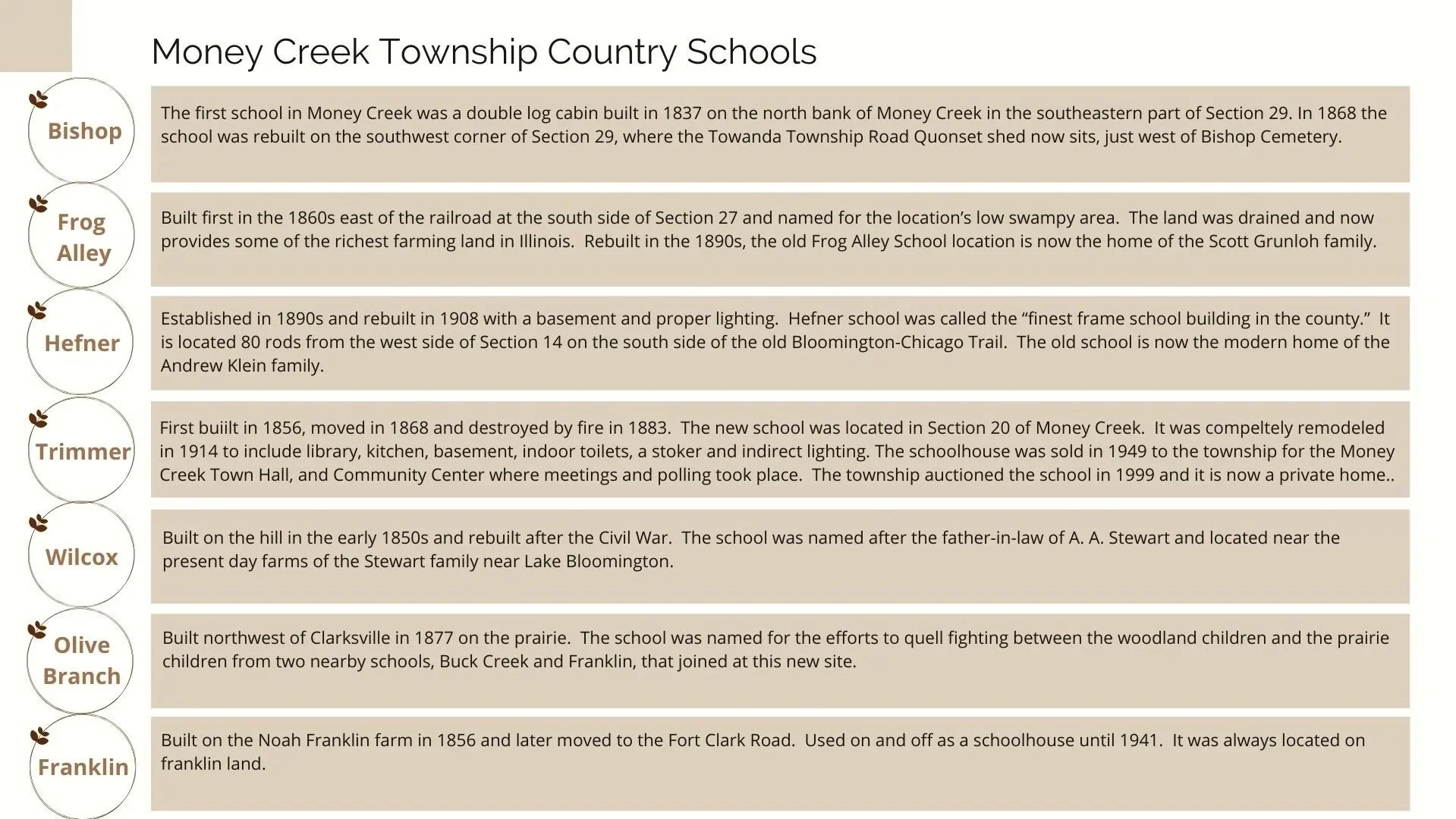
Townships of Lexington, Lawndale, Chenoa and Gridley will be available soon. Photos are being organized for display

“Usually the public schools serve as the standard by which a town is judged and this newspaper can with pride point to the excellence of work done within the brick walls of Lexington’s public school buildings. Good schools speak volumes for the intelligence and advancement of a community, and it is an important point to every person seeking a new home with his family to know that it is a place where they can educate their children, and the tendency of the community is such as to make them the best men and women.”
— Lexington Unit-Journal archives